Hydrogen Fuel Cell Technology in India: Can FCEVs Shape the Future of Clean Mobility?
Hydrogen Fuel Cell Technology in India: India’s electric mobility conversation has largely revolved around battery electric vehicles (BEVs). Electric scooters, motorcycles, cars, buses and commercial fleets are gradually changing how the country approaches transportation. However, batteries are not the only technology capable of powering electric vehicles.
Hydrogen fuel cell technology presents another route to electric mobility. Instead of storing all the energy in a large rechargeable battery, a fuel cell vehicle stores hydrogen and converts it into electricity inside the vehicle. This electricity powers an electric motor, while the vehicle produces water as its primary tailpipe by-product.
The technology is not entirely new. Countries such as Japan and South Korea have invested in fuel cell vehicles, hydrogen production and refuelling infrastructure. Manufacturers including Toyota and Hyundai have developed passenger vehicles powered by hydrogen fuel cells. India, too, is beginning to evaluate the technology through real-world mobility trials.
The National Green Hydrogen Mission has added further momentum by establishing a national framework for developing green hydrogen production, manufacturing capabilities and associated infrastructure.
However, an important question remains: can hydrogen fuel cell electric vehicles (FCEVs) become commercially practical in India, and where do they fit alongside battery electric vehicles?
The answer depends on several factors, including the cost of producing hydrogen, the availability of refuelling infrastructure, vehicle economics, supply chains and the type of transportation application being considered.
1. What Is Hydrogen Fuel Cell Technology?
A hydrogen fuel cell is an electrochemical device that converts the chemical energy stored in hydrogen into electrical energy.
Unlike an internal combustion engine, it does not burn hydrogen to generate mechanical power. Instead, it uses an electrochemical reaction between hydrogen and oxygen to produce electricity.
The electricity generated is then used to operate an electric motor.
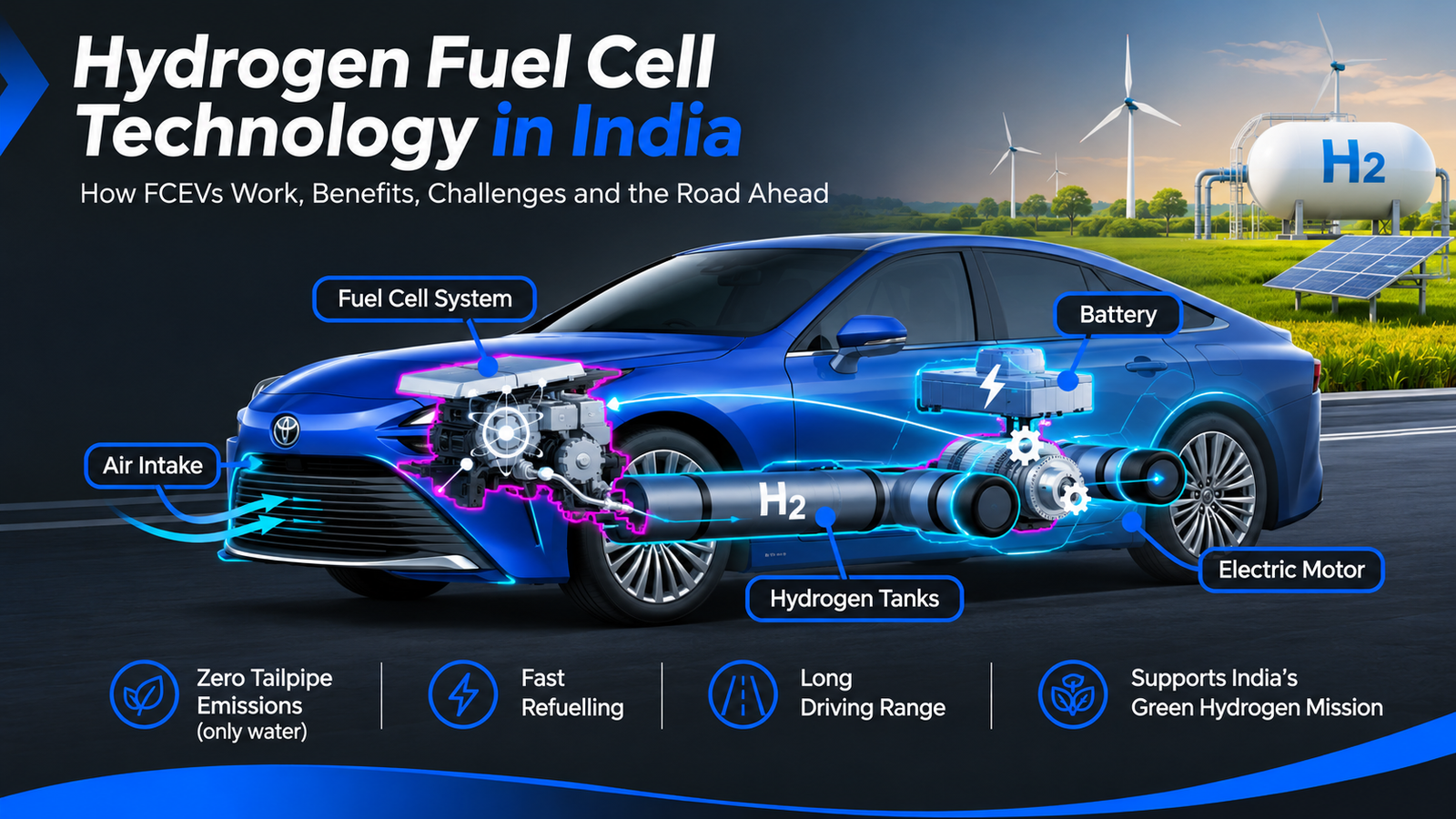
In a typical automotive fuel cell system, hydrogen is stored in high-pressure tanks inside the vehicle. It is supplied to the fuel cell stack, where it reacts with oxygen taken from the surrounding air. This reaction produces electricity, heat and water.
The electricity powers the vehicle’s electric drivetrain. A battery or other energy storage system may also be included to support acceleration, regenerative braking and changes in power demand.
How does a hydrogen fuel cell work?
A commonly used automotive technology is the Proton Exchange Membrane Fuel Cell (PEMFC).
Its operation can be understood through a few basic steps:
- Hydrogen storage: Hydrogen is stored in specially designed high-pressure tanks within the vehicle.
- Hydrogen supply: The stored hydrogen is delivered to the fuel cell stack in a controlled manner.
- Electrochemical reaction: At the anode, a catalyst separates hydrogen into protons and electrons.
- Electricity generation: The protons pass through a proton exchange membrane, while electrons travel through an external electrical circuit, generating usable electricity.
- Oxygen reaction: At the cathode, oxygen from the air combines with the protons and electrons to form water.
- Electric propulsion: The electricity powers the vehicle’s electric motor, which drives the wheels.
The overall reaction is:
2H₂ + O₂ → 2H₂O + Electrical Energy + Heat
The vehicle does not produce carbon dioxide through the fuel cell’s electrochemical reaction. However, the overall environmental impact depends on how the hydrogen was produced, compressed, transported and supplied.
This is a crucial distinction. A fuel cell vehicle running on hydrogen produced using fossil fuels does not offer the same lifecycle emissions benefits as one running on renewable-energy-based green hydrogen.
2. Fuel Cell Electric Vehicles vs Battery Electric Vehicles: What Is the Difference?
Both fuel cell electric vehicles and battery electric vehicles use electric motors for propulsion. The fundamental difference is how they obtain and store the electricity required to move.
A battery electric vehicle stores electricity in a rechargeable battery. The vehicle is connected to an external power source to recharge that battery.
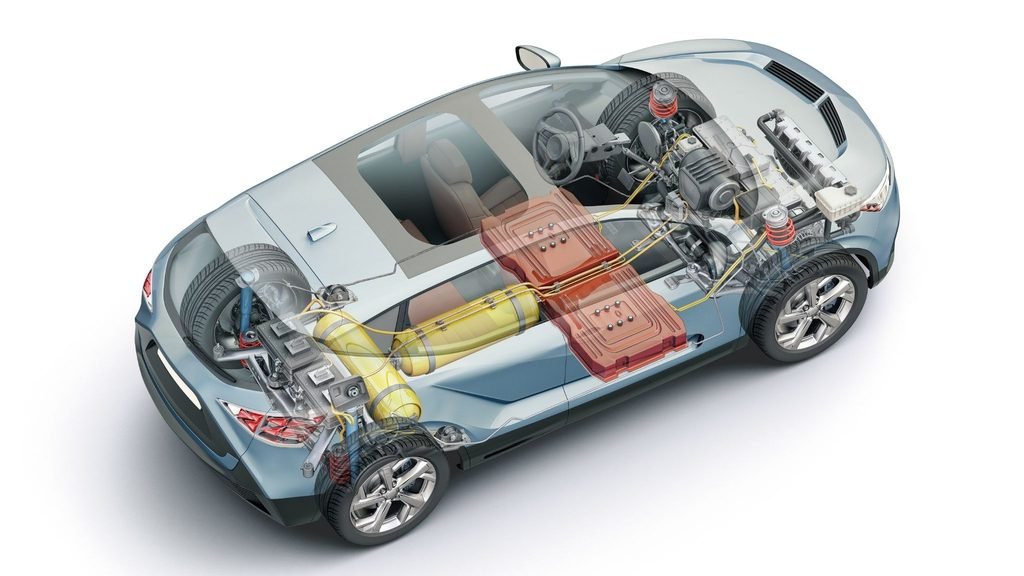
A fuel cell electric vehicle stores hydrogen onboard and generates electricity through an electrochemical process whenever the vehicle requires power. It may also have a smaller battery to support the drivetrain.
In simple terms, a BEV stores electricity, while an FCEV generates electricity onboard using hydrogen.
Key differences between BEVs and FCEVs
| Parameter | Battery Electric Vehicle (BEV) | Fuel Cell Electric Vehicle (FCEV) |
|---|---|---|
| Energy storage | Rechargeable battery | High-pressure hydrogen tanks |
| Energy conversion | Stored electricity powers the motor | Hydrogen is converted into electricity through a fuel cell |
| Propulsion | Electric motor | Electric motor |
| Energy replenishment | Charging from an electrical supply | Refuelling with hydrogen |
| Refuelling or charging time | Depends on battery size and charger | Generally faster than charging a large battery |
| Infrastructure | Electricity grid and charging network | Hydrogen production, transport, storage and refuelling network |
| Tailpipe emissions | No tailpipe emissions | Water is the primary tailpipe by-product |
| Energy efficiency | Generally higher from electricity source to wheels | Lower because hydrogen production, compression and conversion involve additional energy losses |
| Battery requirement | Large traction battery | Usually a smaller battery or hybrid energy storage system |
| Current Indian adoption | Growing commercial market | Early-stage trials and pilot projects |
Which technology is more efficient?
Battery electric vehicles generally have an efficiency advantage because electricity can be supplied directly to the battery and used by the motor.
Hydrogen fuel cell vehicles involve additional conversion stages. Electricity may first be used to produce hydrogen through electrolysis. The hydrogen then needs to be compressed, stored, transported and converted back into electricity inside the vehicle.
Each stage introduces energy losses.
This does not mean FCEVs have no role. Their potential advantages include faster refuelling, longer operating periods between refuelling stops and the possibility of reducing the weight or charging downtime associated with very large battery packs in certain applications.
The more relevant question is not whether hydrogen should replace batteries everywhere. It is where each technology offers the most practical combination of efficiency, operating cost, infrastructure and vehicle performance.
3. What Are the Different Types of Hydrogen?
Hydrogen is often described using colour classifications. These colours do not refer to the physical appearance of hydrogen. They indicate the production pathway and, broadly, its associated emissions.
Understanding the differences is essential when evaluating the environmental benefits of hydrogen-powered vehicles.
| Hydrogen type | Production method | Environmental consideration |
|---|---|---|
| Grey hydrogen | Produced primarily from natural gas through steam methane reforming | Generates significant carbon emissions |
| Blue hydrogen | Produced from fossil fuels, with carbon capture and storage | Can reduce emissions, but the result depends on capture rates and upstream methane emissions |
| Green hydrogen | Produced by electrolysis using renewable electricity | Can have very low production emissions when renewable electricity and the wider supply chain are appropriately managed |
| Brown or black hydrogen | Produced from coal, generally through gasification | Has a high carbon footprint |
Green hydrogen is particularly important for India’s FCEV ambitions.
If hydrogen is produced using renewable electricity from solar, wind or other renewable sources, fuel cell vehicles can become part of a broader low-carbon energy system.
However, the term green hydrogen should not automatically be interpreted as zero-emission hydrogen across its entire lifecycle. Water sourcing, electricity generation, compression, transport and distribution also influence its environmental footprint.
For India, the availability of affordable renewable electricity and the ability to produce hydrogen at scale will play a major role in determining whether FCEVs can become commercially viable.
4. FCEVs in India: From Technology Demonstrations to Real-World Trials
India’s experience with hydrogen-powered vehicles is still at an early stage. However, government agencies, automotive manufacturers and energy companies have begun exploring the technology through demonstration projects and pilot programmes.
These initiatives are important because hydrogen mobility cannot be evaluated through vehicle specifications alone. It needs to be tested under actual operating conditions, including Indian temperatures, road conditions, traffic, maintenance requirements and refuelling limitations.
Two developments deserve particular attention.
The Toyota Mirai and NISE Fuel Cell Vehicle Pilot
The Toyota Mirai is one of the best-known commercially developed hydrogen fuel cell passenger cars.
In March 2022, the Ministry of Road Transport and Highways launched a pilot project involving Toyota Kirloskar Motor and the International Centre for Automotive Technology (ICAT). The project aimed to study and evaluate the Toyota Mirai on Indian roads and under Indian climatic conditions.
The initiative was intended to demonstrate hydrogen fuel cell technology, generate awareness and examine the potential for developing a green hydrogen ecosystem in India.
A subsequent development took place in December 2025, when the Ministry of New and Renewable Energy announced a separate two-year field evaluation programme involving the National Institute of Solar Energy (NISE) and Toyota Kirloskar Motor.
Under this programme, NISE is evaluating the Toyota Mirai in Indian conditions, including:
- High ambient temperatures.
- Dust and varied environmental conditions.
- Traffic congestion and urban driving.
- Different road surfaces and terrain.
- Vehicle performance and operational reliability.
- Requirements for hydrogen supply and refuelling infrastructure.
What is the objective of the NISE-Toyota pilot?
The objective is broader than simply testing whether a hydrogen-powered car can run on Indian roads.
The programme is expected to generate practical information about how FCEVs perform in Indian conditions and what is needed to support their wider adoption. This includes technical evaluation, infrastructure requirements, operational considerations and awareness among stakeholders.
It can also help policymakers, research institutions and automotive manufacturers understand the requirements for developing hydrogen mobility in India.
What is the current status and what are the outcomes?
As of November 2026, the two-year NISE-Toyota evaluation announced in December 2025 is still within its stated testing period. It would therefore be premature to describe it as a completed programme or claim that it has established commercial viability.
The announcement of the pilot is itself a significant development because it represents a structured effort to evaluate hydrogen mobility under Indian operating conditions.
Its eventual findings should help establish a more realistic understanding of vehicle performance, refuelling requirements, operating costs and the challenges of building a supporting ecosystem.
Hyundai NEXO and IndianOil’s Hydrogen Vehicle Trial
Another important development came in April 2025, when Hyundai Motor India and Indian Oil Corporation Limited (IndianOil) announced a partnership to evaluate hydrogen fuel cell vehicles in India.
As part of the initiative, Hyundai handed over a Hyundai NEXO FCEV to IndianOil for real-world testing.
The two-year programme is designed to evaluate the vehicle over an estimated distance of 40,000 kilometres.
The evaluation includes:
- Vehicle longevity and operational reliability.
- Performance under Indian road and climatic conditions.
- Maintenance requirements.
- Total Cost of Ownership (TCO).
- Long-term economic and environmental considerations.
The NEXO is a hydrogen-powered SUV that uses a fuel cell system to generate electricity for its electric motor. It also incorporates a battery to support vehicle operation.
The partnership is significant because IndianOil brings experience in fuel distribution and energy infrastructure, while Hyundai contributes automotive fuel cell technology.
The programme can help assess not just the vehicle but also the practical requirements of operating hydrogen-powered vehicles within India’s existing energy and mobility ecosystem.
Like the NISE-Toyota programme, this is a trial rather than a commercial rollout. Its findings will be important in understanding whether hydrogen passenger vehicles can be economically and operationally viable in India.
5. India’s National Green Hydrogen Mission: Building the Foundation
The National Green Hydrogen Mission is one of the most important policy developments supporting India’s hydrogen ambitions.
Approved by the Union Cabinet in January 2023, the Mission aims to make India a global hub for the production, use and export of green hydrogen and its derivatives.
It has an initial outlay of ₹19,744 crore and a major target of developing at least 5 million metric tonnes of annual green hydrogen production capacity by 2030.
The Mission is not exclusively focused on transportation. Its applications extend across industries such as fertilisers, refineries, steel, shipping, energy storage and other sectors where reducing dependence on fossil fuels can be particularly challenging.
However, the development of a domestic green hydrogen ecosystem could have a direct impact on the future of hydrogen mobility.
What does the National Green Hydrogen Mission aim to achieve?
Its broader objectives include:
1. Increasing green hydrogen production
Developing domestic production capacity can help establish a reliable supply of hydrogen for industrial and mobility applications.
2. Developing electrolyser manufacturing
Electrolysers are essential for producing green hydrogen using renewable electricity. Building domestic manufacturing capabilities can reduce dependence on imported equipment and strengthen India’s industrial supply chain.
3. Reducing the cost of green hydrogen
The economics of hydrogen-powered transport depend heavily on the price of hydrogen. Improving production efficiency, scaling manufacturing and increasing renewable energy availability can help reduce costs.
4. Supporting pilot projects
Pilot programmes allow India to evaluate hydrogen applications in real-world environments, identify technology gaps and understand infrastructure requirements before commercial deployment.
5. Developing hydrogen hubs
Hydrogen production, storage, distribution and consumption can be concentrated in suitable industrial clusters. This approach can reduce transportation challenges and improve the economics of hydrogen supply.
Progress under the Mission
Government updates published during 2026 indicate progress in electrolyser manufacturing, green hydrogen production awards and mobility pilot projects.
Among the developments reported are:
- Incentives awarded for 3,000 MW per annum of electrolyser manufacturing capacity.
- Green hydrogen production capacity commissioned and additional capacity awarded through government-supported programmes.
- Pilot projects involving hydrogen-powered buses and trucks.
- Plans for hydrogen refuelling stations supporting designated mobility routes.
These developments indicate that India is beginning to move beyond policy announcements towards building production and mobility infrastructure.
However, awarded capacity, commissioned capacity and actual hydrogen production are different measures. They should not be treated as interchangeable when assessing the Mission’s progress.
For FCEVs to become commercially viable, the Mission’s progress must eventually translate into affordable hydrogen, reliable distribution and accessible refuelling infrastructure.
6. The Infrastructure Challenge: What Does India Need for Hydrogen Mobility?
A hydrogen-powered vehicle requires a supporting ecosystem that is considerably different from the charging network used by battery electric vehicles.
The infrastructure challenge begins well before hydrogen reaches the vehicle.
Hydrogen must be produced, purified, compressed or otherwise conditioned, stored, transported and dispensed through specialised equipment.
Every stage adds cost, technical requirements and operational complexity.
1. Hydrogen production facilities
Green hydrogen is generally produced through electrolysis, where electricity is used to separate water into hydrogen and oxygen.
For this process to deliver meaningful environmental benefits, the electricity should come from renewable sources.
India has significant solar and wind energy potential. However, renewable energy availability, electrolyser utilisation, water sourcing and production economics all influence the cost of hydrogen.
2. Hydrogen storage
Hydrogen has a high energy content by weight but a low energy density by volume under normal conditions.
This means that storing sufficient hydrogen for a vehicle requires specialised storage systems.
Automotive FCEVs typically use high-pressure composite tanks, commonly designed for pressures of up to 700 bar in passenger vehicles.
These tanks must meet demanding requirements for strength, durability, impact resistance and safety.
Developing domestic manufacturing capabilities for these systems will be important for reducing costs and building a reliable supply chain.
3. Hydrogen transportation and distribution
Hydrogen is difficult to transport economically because of its low volumetric density.
Depending on the application and distance, it may be transported through pipelines, specialised tube trailers or in other forms such as liquid hydrogen or hydrogen carriers.
Each method involves different infrastructure, energy requirements and costs.
For India, developing hydrogen production close to major industrial consumers and transport corridors could help reduce distribution costs.
4. Hydrogen refuelling stations
A hydrogen refuelling station is not simply an alternative to an electric vehicle charging point.
It requires specialised storage vessels, compressors, cooling systems, dispensing equipment, safety controls and monitoring systems.
The stations must also maintain appropriate hydrogen purity and dispensing pressure for the vehicles being served.
Establishing a nationwide network would require significant investment and coordination between energy companies, automotive manufacturers, infrastructure developers and government agencies.
5. Safety and technical standards
Hydrogen is a highly flammable gas. Its small molecular size also makes leakage detection and material compatibility important considerations.
A safe hydrogen ecosystem requires appropriate standards for storage tanks, pipelines, valves, compressors, refuelling equipment, vehicle systems and emergency response.
India will need consistent technical standards, testing facilities, trained personnel and operating procedures as hydrogen mobility expands.
7. What Are the Biggest Bottlenecks for FCEV Adoption in India?
The technology has demonstrated its ability to power passenger vehicles and commercial transport applications. The larger challenge is making the complete ecosystem commercially viable.
Several barriers need to be addressed.
High vehicle and component costs
Fuel cell stacks, hydrogen storage tanks, power electronics and other specialised components add to vehicle costs.
Some fuel cell systems also depend on materials such as platinum-group metals. Reducing material intensity and improving manufacturing scale will be important for lowering costs.
Expensive green hydrogen
The cost of hydrogen directly affects the operating economics of an FCEV.
Even if a vehicle is efficient and quick to refuel, expensive hydrogen can make it difficult to compete with battery electric vehicles or conventional fuels.
Production costs must come down, and the benefits of renewable electricity need to translate into affordable hydrogen at the refuelling station.
Limited refuelling infrastructure
A vehicle cannot become a practical mobility option if users do not have convenient access to fuel.
Without sufficient refuelling stations, FCEV adoption is likely to remain restricted to controlled fleets, demonstration projects and locations with dedicated hydrogen supply.
Dependence on specialised supply chains
Fuel cell stacks, membranes, catalysts, compressors, high-pressure tanks and other components require specialised manufacturing capabilities.
Developing domestic expertise and reliable supply chains will be important for reducing costs and avoiding excessive import dependence.
Skilled workforce and maintenance ecosystem
Fuel cell systems require trained technicians, specialised diagnostic equipment and appropriate service infrastructure.
India will need to develop technical expertise across vehicle servicing, hydrogen production, storage, transportation and refuelling.
Competition from battery electric vehicles
Battery electric vehicles already have a growing manufacturing base, expanding charging infrastructure and established consumer familiarity.
In many passenger vehicle and two-wheeler applications, BEVs also have an efficiency and cost advantage.
For FCEVs to compete, they need to demonstrate a clear operational advantage rather than simply offering an alternative powertrain.
8. Where Do Hydrogen Fuel Cell Vehicles Make the Most Sense?
Hydrogen should not be viewed as a universal replacement for batteries.
Different vehicle categories have different energy requirements, operating patterns, payload constraints and refuelling needs.
The commercial potential of FCEVs is likely to be strongest in applications where fast refuelling, long operating hours and high energy requirements can justify the additional infrastructure and vehicle costs.
| Vehicle category | Potential for FCEVs | Key consideration |
|---|---|---|
| Passenger cars | Selective | Competes with BEVs, which generally have lower energy conversion losses and better-established charging infrastructure |
| City buses | Possible | Centralised depots can support dedicated hydrogen refuelling |
| Intercity buses | Potentially relevant | Long routes and limited downtime can make fast refuelling attractive |
| Heavy-duty trucks | Strong potential in selected use cases | High energy demand, payload and operating hours may favour hydrogen in certain applications |
| Industrial and port vehicles | Promising | Controlled operating environments can support dedicated hydrogen infrastructure |
| Two-wheelers | Technically possible, but commercially challenging | Packaging, tank size, cost and limited infrastructure are major constraints |
The most sensible approach for India may be to begin with concentrated use cases rather than attempting to create a nationwide hydrogen refuelling network immediately.
For example, a fleet of hydrogen-powered trucks operating between industrial hubs could use a limited number of strategically located refuelling stations. This is easier to plan than supporting individual passenger vehicles spread across thousands of cities and towns.
9. Can Hydrogen Fuel Cell Technology Be Used in Two-Wheelers?
Yes. Hydrogen fuel cell technology can technically be adapted for two-wheelers. However, the engineering and commercial challenges are considerably different from those of passenger cars, buses and trucks.
A two-wheeler has limited space for energy storage, propulsion components and supporting systems. It also has strict weight, cost and packaging requirements.
This makes the integration of a fuel cell system more challenging.
How would a fuel cell two-wheeler work?
A hydrogen-powered two-wheeler would broadly follow the same operating principle as a fuel cell car.
It would include:
- A hydrogen storage system.
- A fuel cell stack to generate electricity.
- An electric motor to drive the wheel.
- Power electronics to manage electrical output.
- A battery or buffer energy storage system.
- Hydrogen supply and safety controls.
The fuel cell would generate electricity using hydrogen, while the motor would provide propulsion.
A small battery could help manage sudden power demands during acceleration and capture energy through regenerative braking.
Why are fuel cell two-wheelers difficult to develop?
1. Hydrogen storage occupies valuable space
A two-wheeler has limited space compared with a car. Accommodating a high-pressure hydrogen tank while maintaining practical proportions, weight distribution and safety is a major engineering challenge.
2. Vehicle weight and balance
Fuel cell stacks, tanks, regulators and supporting components add weight. Integrating them without compromising handling, stability and usability requires careful design.
3. Cost of the fuel cell system
Fuel cell stacks and their associated components are relatively expensive. For a price-sensitive two-wheeler market such as India, this can make the vehicle difficult to commercialise.
4. Refuelling infrastructure
India’s hydrogen refuelling network is still at an early stage. Building a dedicated network for two-wheelers would be difficult to justify without substantial vehicle demand.
5. Battery electric vehicles already serve the category
Battery-powered scooters and motorcycles are becoming increasingly practical for urban commuting. They benefit from existing electricity infrastructure, home charging and a growing public charging ecosystem.
A hydrogen two-wheeler would therefore need to offer a compelling advantage in range, refuelling convenience, weight or operating economics to justify its additional complexity.
Could fuel cell two-wheelers become viable in the future?
Potentially, yes.
Research and development could improve fuel cell stack size, power density, hydrogen storage systems and overall component costs.
However, the technology would need to solve the packaging and infrastructure challenges while competing against increasingly capable battery electric two-wheelers.
For India’s two-wheeler market, battery electric vehicles are likely to remain the more practical near-term solution. Fuel cell two-wheelers are better viewed as a possible future research and development pathway rather than an immediate commercial alternative.
10. The Future of Energy Systems: Hydrogen Alongside Batteries
The future of clean mobility is unlikely to depend on a single technology.
Battery electric vehicles, hydrogen fuel cells, renewable electricity, energy storage, biofuels and other emerging technologies may each serve different applications.
For example, battery electric vehicles can be particularly effective for daily urban commuting, where vehicles return home or to a depot for charging.
Hydrogen could become relevant in applications where vehicles operate for long hours, cover substantial distances or face constraints associated with carrying and charging very large battery packs.
This distinction is important for India’s energy transition.
The country needs to reduce its dependence on imported fossil fuels while building an energy system that can support its expanding transportation and industrial requirements.
Green hydrogen can contribute beyond mobility. It can potentially replace fossil fuel-based hydrogen in refineries and fertiliser production, support lower-carbon steelmaking, and provide an energy carrier for selected industrial applications.
The development of renewable energy, electrolysers, fuel cell stacks, hydrogen storage systems and distribution networks could also create opportunities for domestic manufacturing and technical innovation.
However, hydrogen should be deployed where it offers a practical advantage. Using renewable electricity directly is generally more efficient than converting it into hydrogen and then converting it back into electricity. This makes direct electrification preferable in many applications where it is technically and economically feasible.
The long-term energy system will therefore need to balance efficiency, reliability, cost, resource availability and the specific requirements of each sector.
11. What Needs to Happen Before FCEVs Can Scale in India?
India has made an important start through the National Green Hydrogen Mission and its early mobility pilots. But moving from demonstration projects to commercial adoption will require progress across several areas.
Affordable green hydrogen: Production costs need to become competitive, supported by renewable energy, efficient electrolysers and larger production volumes.
Domestic manufacturing: India needs stronger capabilities in fuel cell stacks, membranes, catalysts, hydrogen tanks, compressors and associated components.
Strategic refuelling infrastructure: Initial infrastructure should prioritise industrial clusters, ports, freight corridors and fleet depots where demand can be concentrated.
Reliable supply chains: Hydrogen purity, transportation, storage and dispensing must be consistent and commercially dependable.
Real-world performance data: Pilot programmes should generate transparent information about vehicle performance, maintenance, fuel consumption, operating costs and safety.
Clear regulations and standards: Consistent standards for hydrogen production, storage, transportation, refuelling and vehicle certification will be essential.
Commercial use-case selection: Deployment should begin where hydrogen offers a genuine operational or economic advantage over direct battery electrification.
The success of FCEVs will depend less on the number of vehicle demonstrations and more on whether India can develop a dependable and affordable hydrogen ecosystem around them.
Frequently Asked Questions
1. What is hydrogen fuel cell technology?
Hydrogen fuel cell technology converts the chemical energy stored in hydrogen into electricity through an electrochemical reaction. The electricity powers an electric motor, while water is the primary tailpipe by-product.
2. What is the difference between a fuel cell vehicle and a battery electric vehicle?
A battery electric vehicle stores electricity in a rechargeable battery and uses it to power an electric motor. A fuel cell electric vehicle stores hydrogen and generates electricity onboard through a fuel cell stack. Both use electric motors, but their energy storage and replenishment systems are different.
3. Are hydrogen fuel cell vehicles available in India?
India has begun evaluating hydrogen fuel cell vehicles through pilot programmes. These include the Toyota Mirai evaluation involving NISE and the Hyundai NEXO trial with IndianOil. These programmes are not equivalent to widespread commercial availability.
4. What is the NISE-Toyota hydrogen vehicle pilot?
The NISE-Toyota programme is a two-year field evaluation announced in December 2025. It involves testing the Toyota Mirai under Indian road and climatic conditions to generate information about FCEV performance, operational requirements and hydrogen mobility infrastructure.
5. What is the Hyundai NEXO trial in India?
Hyundai Motor India and IndianOil announced a two-year trial in April 2025, involving a Hyundai NEXO fuel cell vehicle. The programme is expected to evaluate the vehicle over approximately 40,000 kilometres, including reliability, maintenance and total cost of ownership.
6. What is the National Green Hydrogen Mission?
The National Green Hydrogen Mission is an Indian government initiative approved in January 2023 with an initial outlay of ₹19,744 crore. It aims to establish India as a global hub for green hydrogen production, usage and export, with a target of at least 5 million metric tonnes of annual production capacity by 2030.
7. Are hydrogen fuel cell vehicles better than battery electric vehicles?
Neither technology is universally better. BEVs generally have higher energy efficiency and benefit from an established electricity network. FCEVs can offer faster refuelling and may be suitable for selected heavy-duty or high-utilisation applications. Their suitability depends on vehicle requirements, hydrogen availability and total operating costs.
8. Can hydrogen fuel cells be used in electric two-wheelers?
Yes. A fuel cell system can technically generate electricity to power a two-wheeler’s electric motor. However, the limited space for hydrogen storage, vehicle weight, system cost and lack of refuelling infrastructure make commercial adoption challenging.
9. Do hydrogen fuel cell vehicles produce emissions?
FCEVs do not produce carbon dioxide through the fuel cell’s electrochemical reaction. Water is the primary tailpipe by-product. However, their overall environmental impact depends on hydrogen production, compression, transportation and distribution. Green hydrogen offers the strongest potential for reducing lifecycle emissions.
10. Is green hydrogen the future of transportation in India?
Green hydrogen could become an important part of India’s future energy system, particularly for selected heavy-duty transport and industrial applications. However, battery electric vehicles are likely to remain more practical in many urban mobility and two-wheeler applications. Both technologies can contribute to India’s decarbonisation goals.
Conclusion: Hydrogen Will Have a Role, But Not Every Vehicle Needs It
Hydrogen fuel cell technology represents an important development in the evolution of clean energy and transportation. It offers an alternative way to power electric vehicles, with potential advantages in refuelling time and certain high-utilisation applications.
India’s National Green Hydrogen Mission, the NISE-Toyota Mirai evaluation and the Hyundai NEXO trial with IndianOil demonstrate that the country is beginning to examine the technology beyond theoretical discussions.
However, commercial adoption will depend on much more than vehicle performance. Affordable green hydrogen, reliable refuelling infrastructure, domestic manufacturing, safety standards and a skilled maintenance ecosystem will all be essential.
For heavy-duty transport, intercity operations and selected industrial applications, hydrogen could become an important option as the supporting ecosystem develops.
For passenger cars and particularly two-wheelers, battery electric vehicles currently have practical advantages in efficiency, infrastructure and overall system simplicity. Fuel cell two-wheelers remain technically possible, but their commercial case needs considerable development.
The future of mobility in India will not necessarily be a competition in which one technology replaces every other. It will be shaped by choosing the right energy solution for the right application.
Hydrogen may not power every vehicle on India’s roads, but it could become an important part of the country’s broader transition towards a cleaner, more diversified and energy-secure transportation system.
Disclaimer: This article is intended for general informational and educational purposes only. The technology developments, pilot programmes, government policies, targets and project updates discussed are based on information available at the time of writing and may change. Pilot projects should not be interpreted as confirmation of commercial readiness or guaranteed future outcomes. Readers should verify technical specifications, project status, regulatory requirements and policy details through official sources before making business, investment or technology decisions. Gravton Motors Pvt. Ltd. cannot be held responsible for errors, omissions, or the insights and opinions shared in this article, or for decisions made based on its contents.
Research Sources and References
The following sources were consulted while preparing this article. They provide additional information on hydrogen fuel cell technology, India’s hydrogen mobility initiatives, government policies, infrastructure requirements and lifecycle emissions.
- Ministry of New and Renewable Energy, December 2025: India Advances Green Hydrogen Mobility with NISE-Toyota Fuel Cell Vehicle Pilot. Press Information Bureau.
- Ministry of Road Transport and Highways, March 2022: Toyota Mirai Hydrogen Fuel Cell Electric Vehicle Pilot Project Launched in India. Press Information Bureau.
- Business Standard / PTI, April 2025: Hyundai Teams Up with IndianOil to Test Hydrogen Fuel Cell Vehicle in India. Business Standard.
- Ministry of New and Renewable Energy, December 2025: Government Highlights Progress Under National Green Hydrogen Mission to Reduce Green Hydrogen Costs. Press Information Bureau.
- Ministry of New and Renewable Energy, July 2026: Centre Launches 12 Pilot Projects Under National Green Hydrogen Mission for Deployment of 70 Hydrogen-Powered Vehicles Across 21 Routes. Press Information Bureau.
- Bureau of Indian Standards: eMobility R&D Roadmap for India. Technical reference covering hydrogen storage, fuel cell technology, component development, safety and refuelling infrastructure.
- The Energy and Resources Institute (TERI), 2024: Roadmap for India’s Energy Transition in the Transport Sector. Research report examining India’s transport demand, alternative fuel technologies and emissions reduction pathways.
- International Journal of Hydrogen Energy, February 2025: Comparative Life Cycle Analysis of Hydrogen Fuel Cell Electric Vehicles and Battery Electric Vehicles: An Indian Perspective. Research paper comparing lifecycle greenhouse gas emissions of FCEVs and BEVs under different hydrogen production pathways and Indian electricity scenarios.